Not long ago, CAR-T cell therapy was available only at a handful of major academic medical centers. For patients who needed it, that often meant traveling far from home, staying near a treatment facility for weeks, and navigating a system that felt distant from the community-based care they were used to. For many, logistics alone were a barrier.
That picture has changed significantly. CAR-T therapy is reaching more patients, in more places, than ever before. And for patients treated within community oncology practices like The START Center for Cancer Care, that shift has real, practical meaning.
What CAR-T Therapy Is
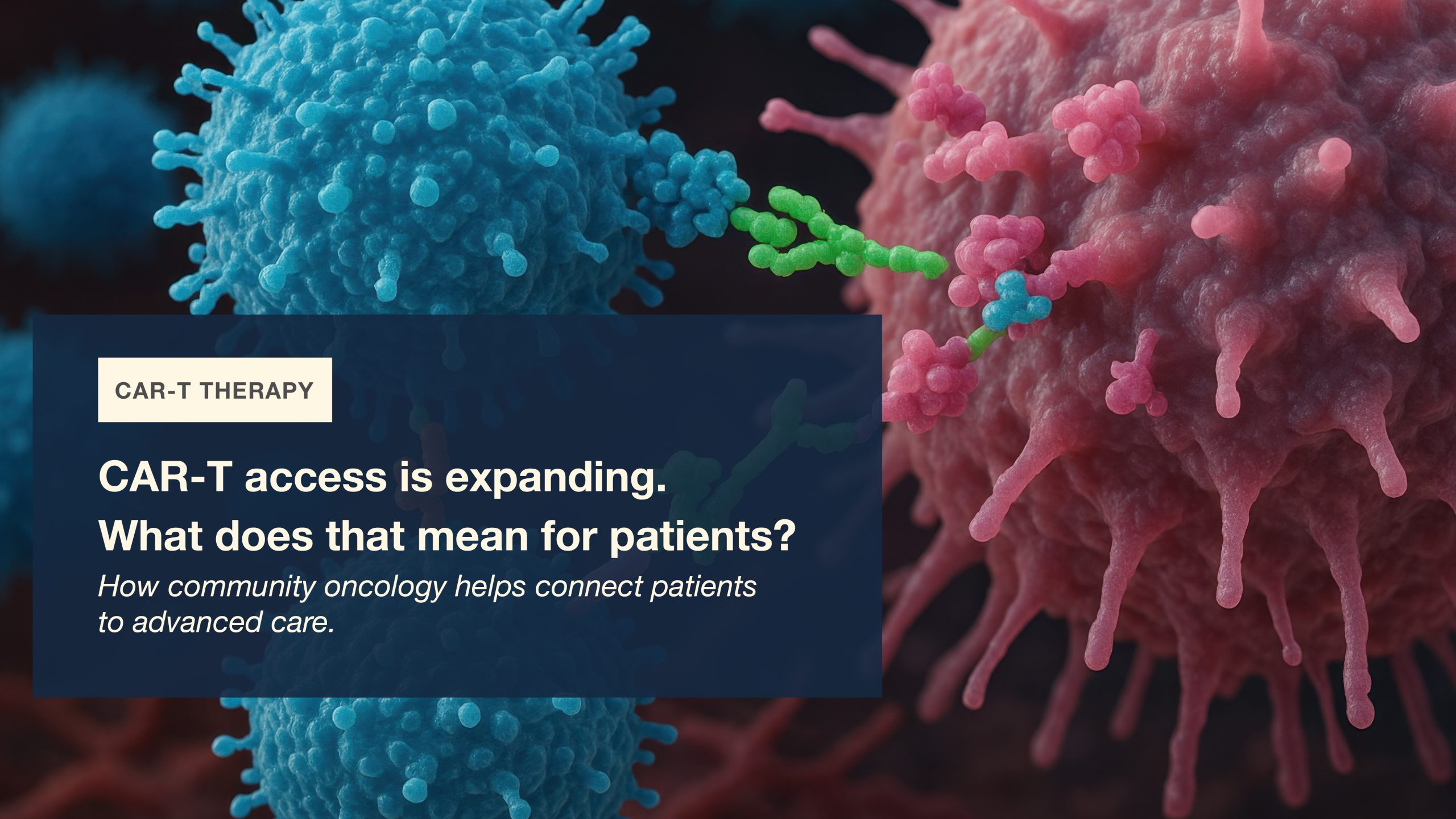
CAR-T stands for chimeric antigen receptor T-cell therapy. It is a form of immunotherapy in which a patient’s own T-cells, a type of immune cell, are collected, genetically modified in a laboratory to recognize and attack cancer cells, and then infused back into the patient.
It is not a standard chemotherapy. It is not a targeted drug. It is a living therapy, engineered from the patient’s own biology, designed to seek out and destroy cancer cells in a way that conventional treatments cannot.
CAR-T has been approved by the FDA for several blood cancers, including certain types of large B-cell lymphoma, follicular lymphoma, mantle cell lymphoma, multiple myeloma, and B-cell acute lymphoblastic leukemia. Research into its use in other cancers, including solid tumors, is actively ongoing.
For patients with certain relapsed or refractory blood cancers, CAR-T therapy has produced remissions in cases where other treatments had stopped working. That is not a small thing.
Why Access Was Limited, and What Has Changed
The early years of CAR-T were defined by complexity. Manufacturing the therapy requires sophisticated cell processing facilities. Administering it requires close monitoring for serious side effects, including cytokine release syndrome (CRS) and immune effector cell-associated neurotoxicity syndrome (ICANS), both of which can be severe and require prompt intervention. The infrastructure demands were significant, and only a small number of certified centers were equipped to meet them.
Over time, that has changed. The number of authorized treatment centers has grown substantially. CAR-T manufacturers have invested in expanding the network of certified sites. Outcomes data has informed better protocols for managing side effects. And the oncology community has developed a deeper collective experience with the therapy that has made administration safer and more predictable.
Community oncology has played a growing role in this expansion. While not every community practice administers CAR-T directly, the integration of community oncology into the broader CAR-T care continuum has meaningfully improved the patient experience. Community oncologists are increasingly involved in identifying appropriate candidates early, coordinating referrals efficiently, managing patients before and after CAR-T, and serving as the ongoing care relationship that academic centers often cannot provide long-term.
What This Means for Patients at The START Center for Cancer Care
For a patient being treated at The START Center for Cancer Care, expanded CAR-T access means several things in practice.
It means that if CAR-T may be appropriate for your diagnosis, the conversation can start here. Your care team knows what to look for, understands the eligibility criteria, and can initiate the evaluation process without you having to find your way to a CAR-T center on your own.
It means that the relationship with our team does not end if you receive CAR-T elsewhere. Long-term follow-up, monitoring for late effects, and ongoing cancer management can continue close to home, with a team that knows you.
And it means that you do not have to figure any of this out alone. If CAR-T comes up as a possibility in your treatment, your care coordinator at The START Center for Cancer Care is the right first call.
Who May Be a Candidate
CAR-T is not appropriate for every patient or every diagnosis. It is typically considered for patients with specific blood cancers that have relapsed or have not responded to prior lines of therapy. Eligibility depends on the type and subtype of cancer, prior treatment history, the patient’s overall health and organ function, and other clinical factors.
The evaluation process is thorough, and not every patient who is referred will ultimately proceed to CAR-T. That is not a failure. It means the process is working as it should, identifying the patients most likely to benefit and ensuring the risks are appropriate for each individual situation.
If you have questions about whether CAR-T could be relevant to your diagnosis, the right starting point is a conversation with your oncologist at The START Center for Cancer Care. We can review your specific situation, discuss what the evidence shows for your cancer type, and help you understand all of your options.
What the Process Looks Like
For patients who do move forward with CAR-T, understanding the process helps reduce some of the uncertainty. In broad terms, it involves several phases.
First, a patient’s T-cells are collected through a process called leukapheresis, in which blood is drawn, the T-cells are separated out, and the remaining blood is returned to the patient. The collected cells are then sent to a manufacturing facility where they are genetically engineered, a process that typically takes several weeks.
While the cells are being manufactured, patients may receive bridging therapy to help keep their cancer stable. When the engineered cells are ready, the patient receives a short course of lymphodepleting chemotherapy followed by the CAR-T infusion itself.
After infusion, patients are monitored closely, typically for at least several weeks near the treatment center, for side effects including CRS and ICANS. Once cleared, ongoing follow-up continues, often in partnership with their community oncology team.
It is a significant undertaking. But for patients for whom it works, the outcomes can be profound.
The Role of The START Center for Cancer Care in Your CAR-T Journey
Whether CAR-T is a current consideration or something that may become relevant down the road, The START Center for Cancer Care is here to help you stay informed and supported every step of the way.